AI tool pricing: what you are actually paying for
Seats, credits, annual prepay and overage — the four levers that decide your real bill, and how each one is set against you.
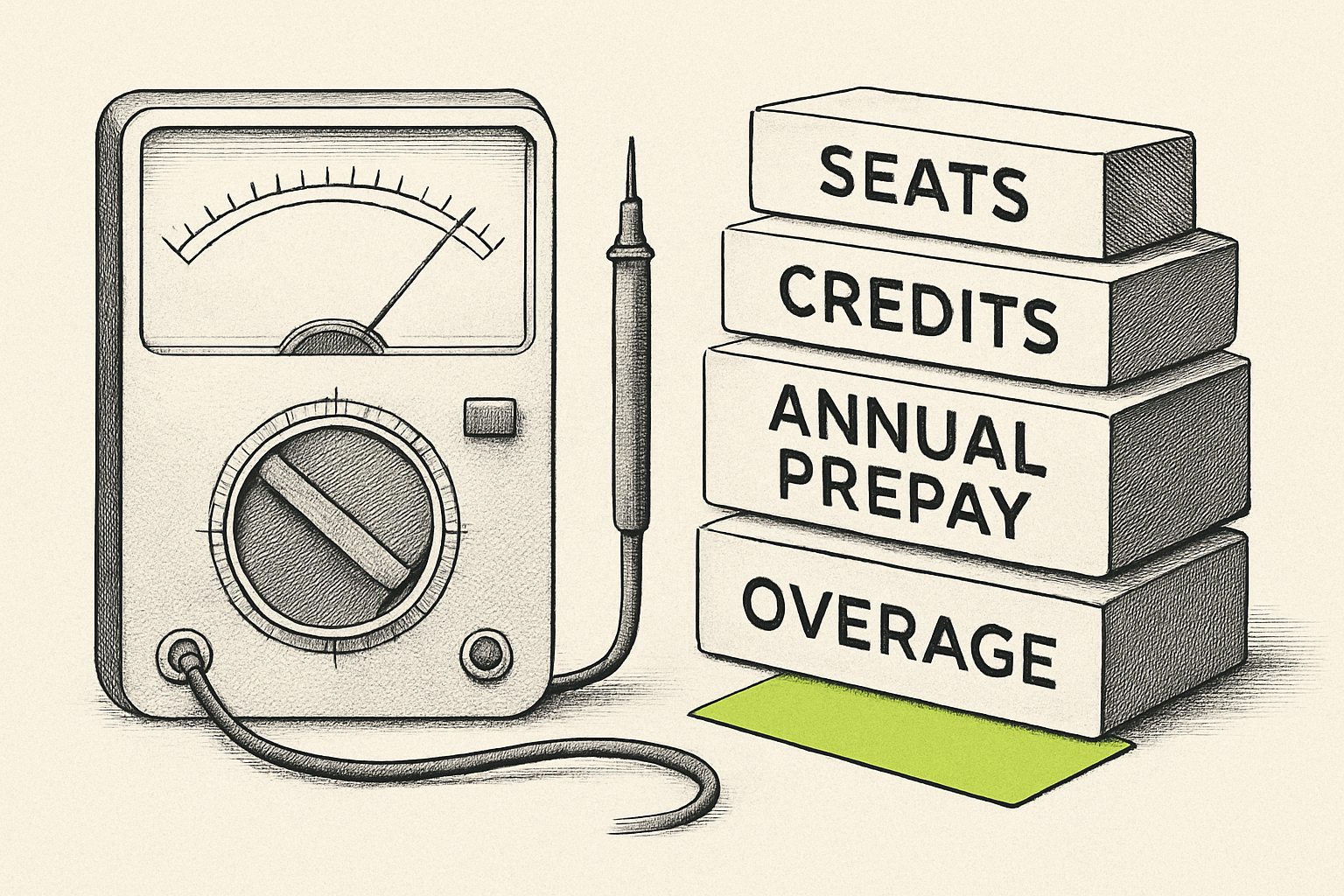
AI generated — machine-made illustration, not a photograph of the event.
Every AI vendor prices on the same four levers. Once you can name which lever a plan is pulling, the comparison stops being about the headline number.
AI tool pricing looks chaotic because vendors are still experimenting. It is not chaotic. There are four levers, and every plan you will be shown is some combination of them.
Lever one: the seat
A seat price is charged per named user per month. It is predictable, which is why buyers like it, and it is the most favourable structure for a vendor whose product has low marginal cost.
The trap is the definition of a seat. Some vendors count anyone who can log in. Others count anyone whose message history exists. Others count a whole workspace as one seat until you add a second admin. Before you commit, ask what happens to the bill when someone leaves and is replaced, and whether a seat can be freed.
For a small team, seats are usually the right structure. You can forecast them, and the ceiling is real.
Lever two: usage credits
Usage pricing meters consumption — messages, tokens, minutes, generations, workflow runs. It is genuinely cheaper for spiky work and genuinely more expensive for steady work, because you pay for the peaks.
The trap is the unit. A credit is not a unit of value, it is a unit the vendor chose. Two tools can both advertise a thousand monthly credits while one spends a credit per sentence and the other per document. Until you convert credits into your own unit of work — one client proposal, one recorded hour, one campaign — the number is unreadable.
Conversion exercise. Take one real task. Run it. Count what it consumed. That single number tells you the effective price, and it is the only price worth comparing.
Lever three: annual prepay
The discount for paying yearly is typically between fifteen and twenty-five per cent. It is real money and it is also a lock-in device, because the refund policy on an annual plan is usually the same as the refund policy on a monthly one: none.
The honest calculation: take the discount, divide it by the number of months you would need to keep using the tool for the prepay to beat monthly, and compare that to how long you actually kept the last three tools you bought. For most small teams, that answer is uncomfortable.
Lever four: overage
This is the lever that produces the surprising invoice. You exceed a limit and the marginal price per unit is set much higher than the bundled price — often several times higher.
Overages are asymmetric by design. You cannot roll unused quota forward, but exceeding it is billed immediately. The mitigation is procedural, not commercial: find the hard spend cap in the billing settings and switch it on before you deploy the tool to the team, not after the first invoice.
Comparing two vendors properly
Put the four levers in a table with four rows: seat cost at your headcount, effective usage cost for one real task, prepay discount and its lock-in, and the overage rate with the cap status. Then add one final row that vendors never put on a pricing page: the cost of switching off, which is the hours to export your data and retrain the team.
A plan that wins the first four rows and loses the last one is not the cheaper plan.
What we don't know
We cannot publish current list prices for every tool and keep them accurate, which is precisely why this article teaches the method instead of printing a table. Any price table on the internet that claims to be current for dozens of AI tools is stale somewhere, and usually in the row you care about.
We also cannot tell you your own effective usage cost without your own task and your own numbers.
What to do next
- For every AI tool you pay for, write down which of the four levers sets your bill. If you cannot name it, you cannot manage it.
- Find and enable the hard spend cap on anything billed by usage.
- Run the conversion exercise on your three most expensive tools this week and compare effective price, not headline price.