Copilot coding agents convert issue descriptions into reviewable pull requests
Describe a change; Copilot can read the repository, edit files, run tests and return a pull request from an Actions-powered isolated environment.
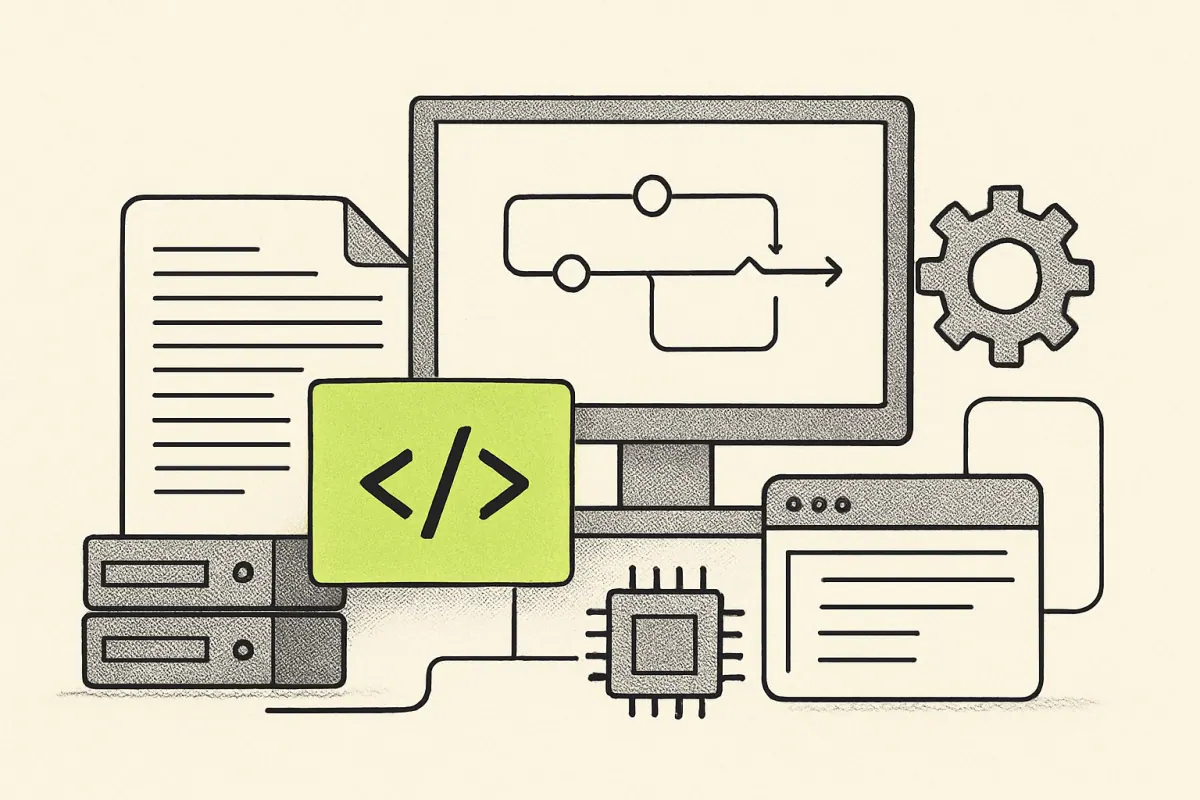
AI generated — machine-made illustration, not a photograph of the event.
Small teams can cut the hours spent on manual edits, local test runs and juggling tabs by asking a Copilot coding agent to implement an issue and return a pull request; review time becomes the main risk checkpoint.
What actually changed
On 15 October 2026 GitHub described a shift in the developer interface where AI systems do more than generate snippets. The platform now lets a Copilot coding agent gather repository context, inspect symbols and dependencies, edit files, run tests and revise implementations inside an interactive loop in the IDE. In agent mode the tool keeps that loop live; for longer, isolated work it can run inside a GitHub Actions–powered environment and return a pull request for human review.
In short: you can move from writing commands and manual edits to describing an outcome and having the system execute the steps needed to reach that outcome, while you retain final ownership of the change.
Who it affects
- Developers who currently spend time switching between editor, terminal, browser and tabs to implement and test changes. The announcement frames the change around the typical developer workflow that relied on keyboard, mouse, editor, terminal and many tabs.
- Reviewers and maintainers, because the output comes back as a pull request that needs human review rather than an immediately merged change.
- Small teams that want to shorten the iteration loop for routine or well-scoped tasks: the system can run tests and surface failures before code reaches review.
What it costs or what it replaces
- The announcement does not state pricing or licensing details.
- Functionally, the agents reduce dependence on manual sequences: editing files by hand, running local commands, and manually opening and closing multiple tabs to assemble context. The post contrasts the old setup (keyboard, mouse, editor, terminal, browser and many tabs) with the new flow where intent is made executable by the agent.
- Operationally, the main replacement is time spent on mechanical work; the remaining cost is reviewer time and the need to validate the agent’s changes and test results. The developer retains control over boundaries and outcome, so risk shifts from execution to verification.
What we don't know
- Which GitHub plans or account tiers will get access, and whether rollout will be staged.
- Which IDEs and versions fully support
- GitHub Blog — original reporting
Links above go to the original publisher. Signalcraft states the consequence; it does not reproduce their text.
0 comments
No comments yet. If you have run any of this, that is the most useful thing you could add.