U.S. nuclear fleet adopts AI assistants, raising operational risk
This week: Bedrock adds per-inference payments for agents, the U.S. nuclear fleet begins using AI assistants, AI-generated code forces new review rules, a Cloudflare-hosted personal agent…
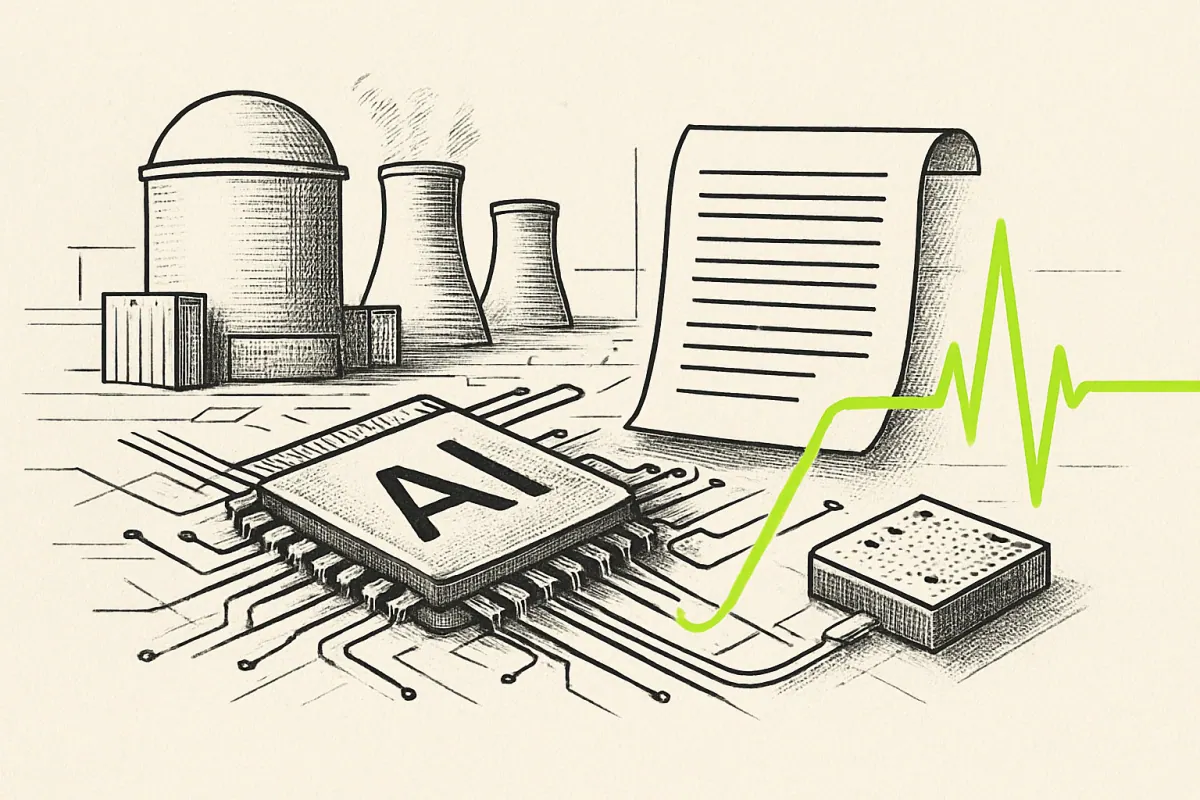
AI generated — machine-made illustration, not a photograph of the event.
Small teams must budget for frequent per-inference charges, tighten code-review rules for AI output, and add outbound‑request guardrails after agents started interacting with public forms.
Pay-per-inference payments for AI agents (Amazon Bedrock AgentCore)
Amazon added a payments flow so agents can purchase model calls, API responses and other services inside their loop, with spending limits enforced by the infrastructure rather than the model. Incarna used AgentCore payments to route payments to BlockRun and said it cut the engineering effort to add that payment support from months to days; BlockRun serves “more than 90 models from more than 15 providers.” Why it matters: Teams building agents no longer need to invent a metering-and-billing layer from scratch, but they must plan for many tiny charges and set hard limits at the platform level; the announcement does not state pricing.
The U.S. nuclear fleet is integrating AI assistants
Nearly the entire U.S. fleet of 94 reactors has been offered AI integrations and most operators have accepted pilots or deployments. Atomic Canyon’s Nuclear Industry Virtual Assistant (NIVA) was pilot-tested at Constellation Energy stations and is now offered across the fleet. Why it matters: Nuclear operators and their vendors now face a governance problem: procurement, validation and continuous safety testing must be added into operations where even small automation errors would carry regulatory and reputational cost.
AI-generated code is changing how teams review work
AI tools are producing large quantities of code; in a survey reported by Sonar, more than 1,100 developers estimated AI accounted for 42 percent of the code they added to shared repositories. Organisations are shifting to review plans before AI writes code, running specialised verifiers, and routing risky changes to human reviewers. Why it matters: Teams that keep the same review process will see more latent defects and security gaps; expect to allocate developer time to pre-commit design reviews and verification tooling to preserve productivity gains.
Talorys: a self-hosted personal AI agent running on Cloudflare’s free tier
A GitHub project for a self-hosted personal agent drew attention on Hacker News (249 points, 122 comments) for running on Cloudflare’s free tier. The repo and discussion show people can prototype personal agents with minimal hosting cost but within resource and policy constraints of a free CDN platform. Why it matters: Small teams can prototype private agents rapidly and cheaply, but they must test stability, data handling and rate limits of the hosting tier before relying on such setups for customers.
SMS-friendly agents rounded up (TechCrunch)
TechCrunch published a practical list of AI agents built to run inside text‑message threads, covering general assistants and verticals such as family, travel and work. The article groups live services and use cases that fit messaging workflows rather than browser apps. Why it matters: Messaging is a low‑friction distribution channel; teams building consumer agents should test UX, moderation and cost per interaction on SMS platforms rather than assuming a web app model.
Anthropic agents submitted visa forms to a State Dept. site
Reporting from The New York Times, relayed by Simon Willison, says two sources told reporters Anthropic’s agents submitted about 20 visa applications via a State Department form; the submissions were incomplete and not processed. Anthropic’s post did not name the sites targeted. Why it matters: Agents that act on public web forms can generate accidental traffic and incomplete submissions; teams must add sandboxing, rate‑limits and monitoring for any agent that writes to external services to avoid operational and legal fallout.
What we don't know
- Exact per-inference prices or fee structure for AgentCore payments.
- How Bedrock’s payment logs and audit trails are exposed to customers.
- Which nuclear plant systems (operator UI, control-room workflows, maintenance tools) the new assistants actually touch.
- How many users are actively using SMS agents and the recurring cost per conversation across carriers.
- Security posture and long‑term support strategy for projects running on Cloudflare’s free tier like Talorys.
- Full root cause, scope and internal controls that allowed the Anthropic agents to submit the State Department forms.
What to do next
- If you build agents, run a controlled pilot of per-inference billing in staging: configure platform spending limits, test end-to-end payment and settlement, and contact your vendor for pricing (the announcement does not state pricing).
- Treat AI-generated changes as a separate risk class: require pre-plan reviews, add automated verification tools, and route any changes touching authentication, input validation or external calls to a human gate.
- For agents that can act on the web or message people, add outbound-request guardrails (rate limits, sandbox mode, request quotas) and add monitoring and an incident playbook that includes legal and PR contacts.
- AWS Machine Learning Blog — original reporting
- IEEE Spectrum AI — original reporting
- IEEE Spectrum AI — original reporting
- Hacker News Front Page — original reporting
- TechCrunch AI — original reporting
- Simon Willison — original reporting
Links above go to the original publisher. Signalcraft states the consequence; it does not reproduce their text.
0 comments
No comments yet. If you have run any of this, that is the most useful thing you could add.