The five jobs AI is already good at
Drafting, summarising, reformatting, sorting and extracting. Almost every successful business use is one of these five.
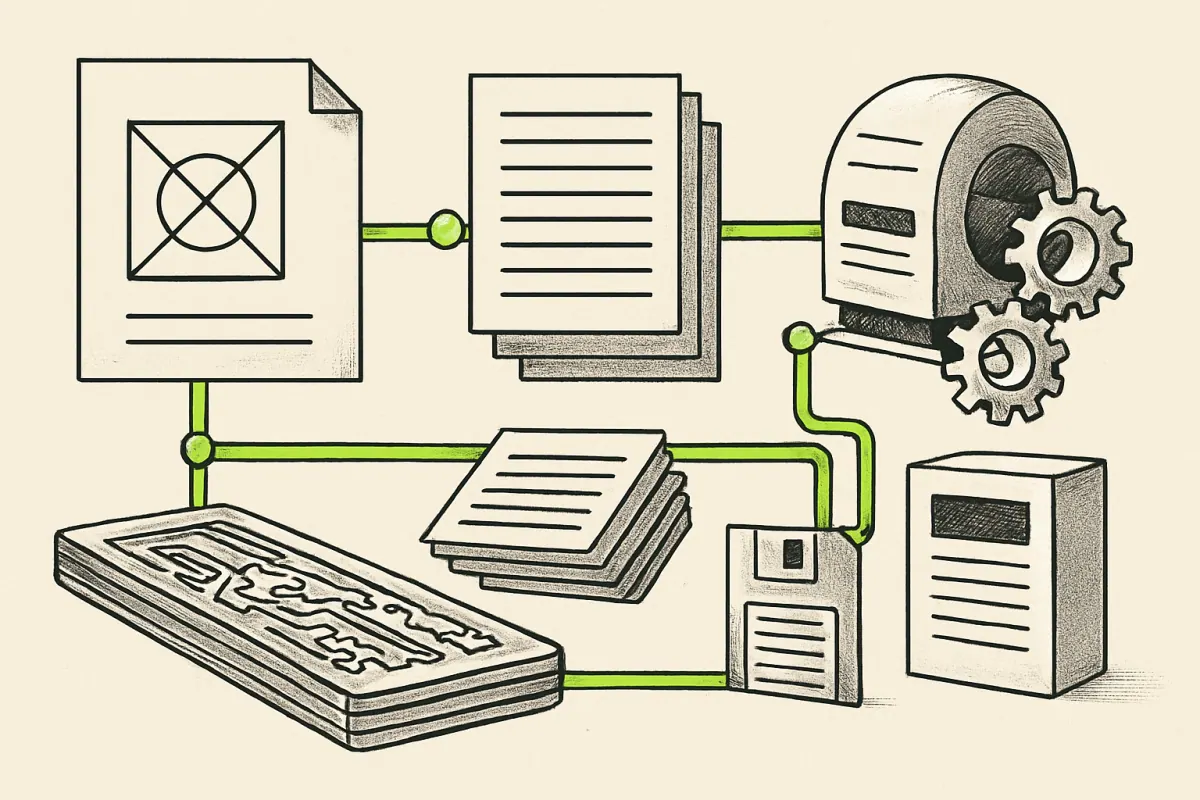
AI generated for this lesson — machine-made illustration.
What you'll be able to do afterwards: Look at any task and decide in seconds whether it is a good fit for AI.
Underneath the noise, almost every genuinely useful business application of AI is one of five activities. Learn the five and you can judge a task in seconds: is this one of them, or am I hoping for something the mechanism cannot do?
1. Drafting
Producing a first version of something from a description plus context.
Where it pays: proposals, follow-up emails, job adverts, meeting agendas, product descriptions, social posts, the first pass at any document nobody enjoys starting.
The economics are straightforward. A blank page costs most people twenty minutes of circling. A rough draft costs seconds, and even a mediocre one tells you what you actually want to say. You are not accepting the draft; you are skipping the part where you stare at nothing.
2. Summarising
Compressing something long into something short, or into a different length for a different reader.
Where it pays: turning a 40-page report into a one-page brief, condensing a long email thread into decisions and open questions, producing meeting notes from a transcript, reading a competitor's announcement and extracting what actually changed.
Two cautions. Long documents can lose detail in the middle, so ask for a section-by-section summary when precision matters. And always ask for a summary of a document you supplied, rather than of something the model half-remembers.
3. Reformatting
Changing the shape of information without changing its content.
Where it pays: converting a rough set of notes into a structured plan, turning a spreadsheet export into a readable summary, moving content between formats, making one piece of writing work at three different lengths.
This is the least glamorous category and often the highest return, because it is pure machine work with an obvious right answer. If a person is copying between formats, that is a candidate.
4. Sorting and classifying
Applying consistent judgement to many items at once.
Where it pays: routing incoming enquiries by type, tagging customer feedback by theme, triaging support tickets, separating genuine leads from noise, flagging which contract clauses need a lawyer's eye.
The value is consistency rather than brilliance. A person classifying two hundred items drifts by item fifty. A model classifies item two hundred the same way it classified item one — and you can read its reasoning and correct the rule. Build the rule once, and it holds.
5. Extracting
Pulling structured fields out of unstructured text.
Where it pays: getting the dates, amounts and names out of invoices and receipts, turning CVs into a comparable table, pulling action items and owners out of minutes, capturing order details from emails.
This is where automation usually starts, because text in and structured data out is the bridge between a document and a system that can do something with it. Every workflow in lesson 6 begins with a step like this.
The test for everything else
If a task is not one of these five, the honest answer is usually that you are asking for judgement or accountability, and those still belong to a person.
- Deciding what matters. A model can rank by criteria you give it. It cannot know what your business should care about.
- Owning a commitment. It can draft a promise. It cannot be responsible for one.
- Knowing your specifics. Your margins, your customer's history, your unwritten rules. Supply them or leave the task alone.
- Being right about facts. It produces likely text. That is a different thing, and lesson 5 is about the gap.
How to audit your own week
Write down the ten tasks that took the most time this week. Against each, mark which of the five it is, or "none". Start with the ones you marked reformatting or extracting — those have the clearest boundaries and the least risk.
You will typically find two or three hours a week that qualify. That is a realistic first target, and it is far more valuable than a grand strategy you never act on.
Next: lesson 4, what this actually costs once you use it seriously.
0 comments
No comments yet. If you have run any of this, that is the most useful thing you could add.