SageMaker SDK v3 targets fleet-wide computer vision at the edge
Today’s releases give operators new ways to manage many camera-specific models, buy AI-powered literature search, and pilot GPT-6-class models for code security and incident triage.
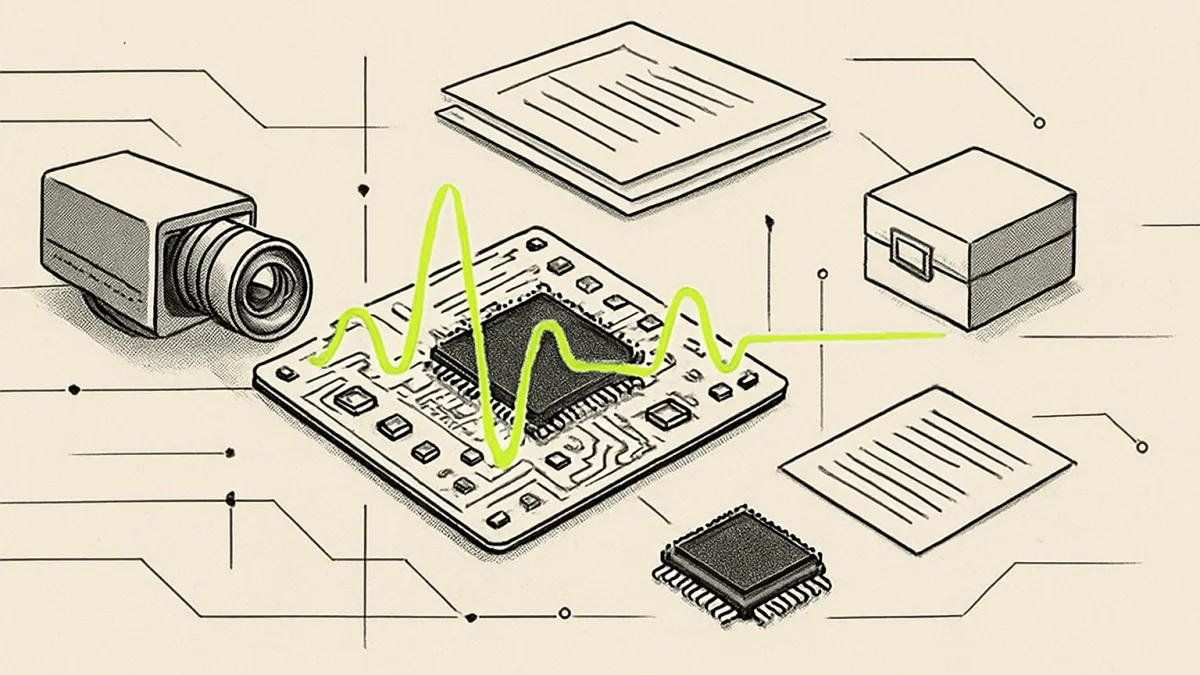
AI generated — machine-made illustration, not a photograph of the event.
Small teams will need to choose between spending engineering hours to manage many edge-specific models or buying subscription tools and model APIs that shave inspection, security and incident time.
AWS SageMaker SDK v3: fleet-wide computer-vision lifecycle at the edge
AWS updated its SageMaker Python SDK to v3 and published a pattern for handling camera-by-camera model management at the edge. The post replaces the since-deprecated SageMaker Edge Manager with Amazon SageMaker Neo for edge optimisation and shows a dual-branch pipeline that trains both anomaly detectors and defect classifiers. It addresses the shift from one model to many, noting teams face training, evaluating, versioning and shipping "thousands" of models when a proof of concept scales.
Why it matters: If you run quality inspection cameras, the SDK pattern gives a repeatable route to automate per-camera fine-tuning and deployment, reducing the need for manual tweaks across production lines.
IEEE Xplore adds an AI Research Suite
IEEE rolled out the IEEE Xplore AI Research Suite on top of the full text of its journals, standards and proceedings, offered as an optional subscription upgrade to institutional Xplore subscribers. The suite is built to surface insights from STEM literature and to drive conversational search workflows, emphasising that answers should be trustworthy. The announcement frames the feature as literature search tuned for scientific publications rather than generic web retrieval.
Why it matters: Research teams and organisations that rely on IEEE content will face a budget decision: pay for the upgrade to speed literature discovery, or keep existing keyword searches and manual reading.
GPT-6.1 Terra: a mid-tier model for vision and computer tasks
OpenAI introduced GPT-6.1 Terra, positioning it between cheaper and more expensive models and emphasising visual reasoning, computer use and clearer technical writing. Commentators note Terra is aimed at the mix of tasks that fill the workday — drafting, interpreting diagrams and repetitive computer work — and that it competes with similar mid-tier offerings. The announcement compares Terra to other models in the family on speed and task fit rather than on price.
Why it matters: If your team automates report drafting, diagram interpretation or form‑filling, Terra is a candidate to trial; the announcement does not state pricing, so compare API cost and latency in a short pilot before committing.
Greptile: GPT-6 Astra applied to workflow testing and security
OpenAI describes how Greptile uses GPT-6 Astra to test user workflows, integrates Daybreak for security reinforcement, and applies Codex to reduce rework. The write-up presents these as parts of a stack that exercise user journeys and find issues beyond simple code review.
Why it matters: QA and product teams can shift some end‑to‑end workflow testing from manual scripts to model-assisted checks, potentially reducing repetitive QA labour and earlier catching workflow regressions.
CodeRabbit and GPT-6.1 Sol for code-security investigations
CodeRabbit says it uses GPT-6.1 Sol to investigate security risks across complex codebases; a security agent surfaces findings and proposed fixes for developer review. The case study focuses on triage and suggested remediation rather than on fully automated patching.
Why it matters: Security teams can use model-assisted triage to reduce the time engineers spend finding and proposing fixes, but human review remains in the loop for validation and deployment decisions.
Codex Ultrafast: incident investigation in minutes at OpenAI
OpenAI reports using Codex Ultrafast to cut incident investigation time "from hours to minutes," applying the tool for faster security analysis, code refactoring and daily engineering workflows. The write-up highlights internal usage rather than a commercial product release.
Why it matters: If incident response is part of your operational cost, a faster investigation workflow reduces downtime and shifts engineering time from firefighting to planned work — validate similar gains on replayed incidents before adopting.
What we don't know
- Exact pricing or licensing terms for SageMaker SDK v3 features and the SageMaker Neo edge optimisation workflow.
- Cost and trial terms for the IEEE Xplore AI Research Suite beyond it being an optional institutional upgrade.
- API pricing, throughput and latency for GPT-6.1 Terra, Astra, Sol and Codex Ultrafast; announcements emphasised capability not price.
- Integration complexity and required engineering effort to apply the SageMaker pattern to a specific camera fleet or to replicate OpenAI’s internal incident playbooks.
- Scale and failure modes for Greptile, CodeRabbit and the security agents in real-world, multi-repo environments.
What to do next
- Inventory: count cameras, model variants and per-camera performance gaps; run a short pilot using the SageMaker SDK v3 pattern on one production line before committing to fleet-wide changes.
- Trial and budget: ask your institution’s IEEE Xplore administrator for a trial or demo of the AI Research Suite and obtain pricing; if you rely on IEEE content, model the subscription cost against estimated time saved.
- Pilot models on narrow tasks: run two-week pilots — use Terra for a document/diagram automation task and Sol or a security agent for one repository — measure false positives, developer review time and API cost before wider rollout.
- AWS Machine Learning Blog — original reporting
- IEEE Spectrum AI — original reporting
- Simon Willison — original reporting
- OpenAI News — original reporting
- OpenAI News — original reporting
- OpenAI News — original reporting
Links above go to the original publisher. Signalcraft states the consequence; it does not reproduce their text.
0 comments
No comments yet. If you have run any of this, that is the most useful thing you could add.