Design agent cognition now or expect repeated production failures
Agents built from prompts and a model prototype quickly, but production breaks when they make judgement calls; design verification, decision flow and fallbacks first.
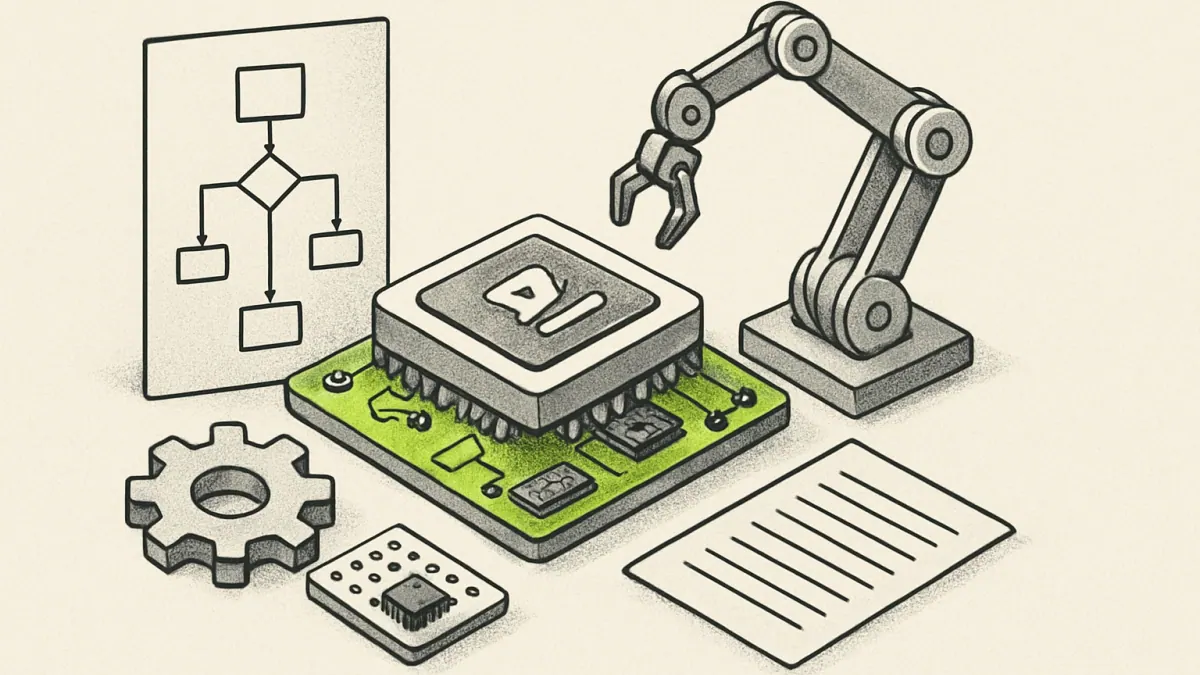
AI generated — machine-made illustration, not a photograph of the event.
Small teams that move from a pilot to production without mapping how an agent thinks will spend more engineering hours fixing skipped validations and logic gaps than they did building the prototype.
What actually changed
You can assemble an agent in days with an open source framework and cloud services, but that no longer guarantees it will behave in a business setting. The AWS summary says teams typically try prompt tweaks, extra examples or different models and still hit the same wall because agents do not follow a fixed sequence of instructions. Instead, you must "design the agent’s entire cognitive architecture and execution flow" — decide how the agent reasons, when it verifies outputs and what it does when things fail.
That shifts the engineering work. Prompt design is still necessary, but it becomes a component inside a larger system: decision points, verification checkpoints and explicit error behaviours.
Who it affects
- Product managers and owners who rely on agents to enforce business logic must budget time for flow design, not just prompt experiments.
- Engineers and ML practitioners who currently focus on model selection and prompt tuning will need to add structured checks and defined fallbacks to their deliverables.
- Operations and QA teams that assume a deterministic sequence will need to test judgement-based paths and edge cases rather than only happy-path flows.
The change matters most for any team taking an agent beyond a demo into a live workflow where skipped validations or missed edge cases cause customer or compliance harm.
What it costs or what it replaces
This approach replaces a cycle of endless prompt tweaks with explicit design work: mapping decision points, inserting verification steps and defining failure modes. The immediate cost is engineering time to design and implement those controls and to expand test coverage to the non-deterministic branches of agent behaviour.
The AWS post introduces Deep Insight as a solution the AWS Solutions Architecture team built to tackle these production challenges. The announcement does not state pricing.
What we don't know
- Exactly which engineering artefacts Deep Insight produces or expects teams to provide.
- Whether Deep Insight is available as open source, a managed service, or both.
- The operational requirements (hosting, integrations) that Deep Insight needs to sit alongside existing stacks.
- Any limits, quotas or pricing details for teams that want to adopt it.
What to do next
- Map one end-to-end task this week: pick a single business workflow where an agent will make decisions. Draw the sequence of steps, then mark every decision point where the agent might deviate from a fixed script.
- Add three control layers for that workflow: (a) verification checkpoints that confirm the agent respected business rules before moving on, (b) explicit fallback behaviours for when verification fails, and (c) logging points that capture the agent’s rationale and inputs for post‑mortem.
- Run a short pilot that focuses on failure modes: exercise edge cases and judgement paths using representative inputs, record failures, then turn those failures into either a verification rule, a clarified instruction in the flow, or a fallback routine. Iterate until the most common failure modes are covered.
These steps replace week‑after‑week prompt fiddling with a repeatable design loop you can budget and staff for. Start with one workflow this week and reuse the pattern across other agents.
- AWS Machine Learning Blog — original reporting
Links above go to the original publisher. Signalcraft states the consequence; it does not reproduce their text.
0 comments
No comments yet. If you have run any of this, that is the most useful thing you could add.