ECHOES cuts GUI inference costs by compressing visual history, but adds training work
A new method compresses GUI screenshot histories into recursive text and uses a privileged-image teacher for on-policy distillation — that lowers inference token use but requires extra…
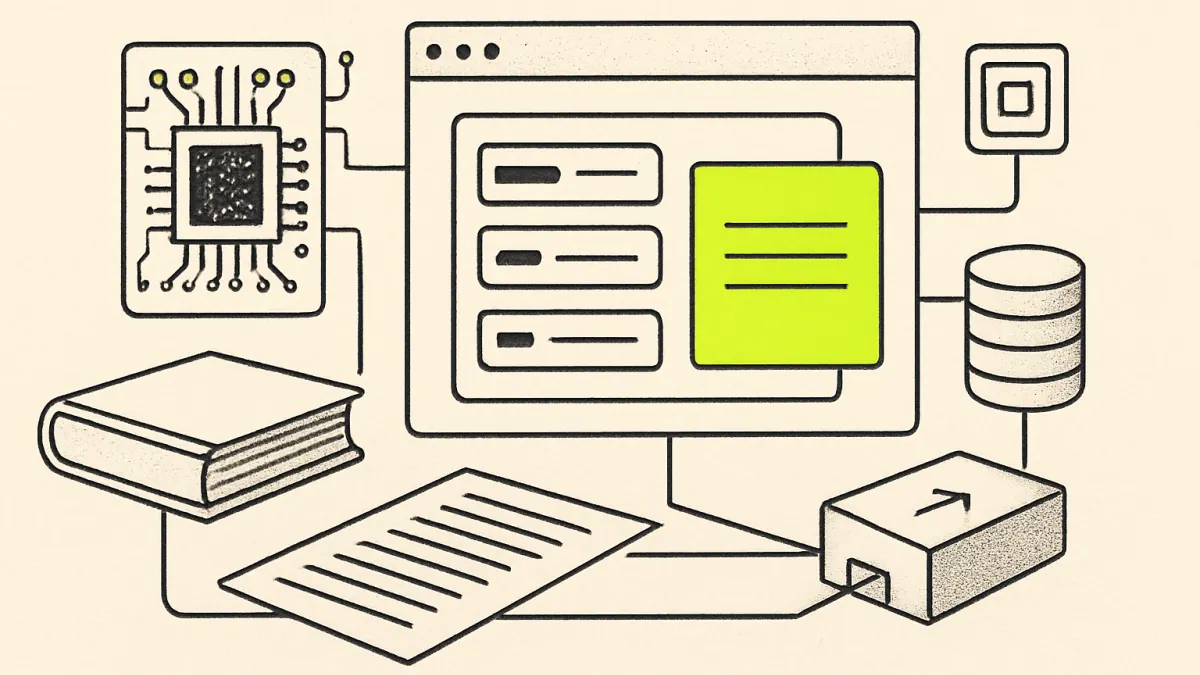
AI generated — machine-made illustration, not a photograph of the event.
ECHOES aims to lower the runtime cost of long-horizon GUI agents by shrinking visual history into a maintained textual state, but it requires extra training-time data and a teacher–student reinforcement learning loop that increases engineering and compute work.
What actually changed
The paper introduces ECHOES, a training framework that converts multi-image visual histories into a compact, updatable textual state and then reasons from that text during deployment. The method uses a labelled teacher model that receives privileged multi-image inputs at training time and provides dense, token-level on-policy distillation to a student that generates and updates textual rollouts. The authors formalise the text update pattern as a "Compression-Think-Action (CTA)" format that recursively maintains task state. They add a Perception-Memory Fidelity (PMF) Gap-guided OPD-RL process to balance how much the student follows privileged distillation versus chasing task reward, and they schedule periodic teacher updates to keep the teacher aligned with improving student policies. The work also packages a diagnostic benchmark, ECHOESBMK, derived from real GUI agent failure traces to test visual perception and cross-modal state retention.
Who it affects
- Teams building long-horizon GUI automation or agents that currently store many screenshots and face high inference-token use. The paper directly targets the trade-off between visual history retention and inference cost.
- ML engineers who manage inference budgets: the method is designed to reduce the number of visual tokens and runtime image processing by replacing persistent screenshot histories with a maintained textual memory.
- Research and product teams that can supply training-time privileged data (multi-image inputs) and are willing to run teacher–student RL distillation and periodic teacher updates during training.
What it costs or what it replaces
- What it replaces: persistent storage and repeated processing of long screenshot histories at inference; instead, a compact textual state is updated recursively and used for reasoning. This is presented as a path to cut visual-token usage and runtime inference cost.
- What it adds: training-time complexity and infrastructure. The method depends on a privileged-image teacher that must be available during training and on-policy distillation that runs alongside reward optimisation. The framework includes an OPD-RL loop guided by the PMF gap and scheduled teacher refreshes, implying extra compute and engineering for training pipelines.
- Pricing: the announcement does not state pricing or compute budgets for training or inference.
What we don't know
- How large or costly the privileged teacher model needs to be in practice.
- Numerical effect sizes: the abstract does not report exact improvements on the four GUI benchmarks or ECHOESBMK.
- Whether the authors will release code, pretrained models or the ECHOESBMK dataset in a usable format.
- How well the approach generalises outside GUI tasks or to environments without easily obtained privileged multi-image inputs.
- Implementation details for integrating the CTA-format textual state with a specific LLM or vision encoder.
What to do next
- Read the full arXiv paper (arXiv:2610.22408) and check for linked code or dataset releases; prioritise locating ECHOESBMK and any reproduction notes.
- If you run GUI agents, run a small, one-week experiment: replace persistent screenshot history with a simple recursive textual state (manual or using off-the-shelf summarisation) and measure inference token use and task success to get baseline savings before committing to teacher–student training.
- If the paper provides code or you see promising baseline results, plan a pilot that adds a privileged-image teacher only for training and measures how much extra training time is needed versus your operational inference savings.
- arXiv cs.AI — original reporting
Links above go to the original publisher. Signalcraft states the consequence; it does not reproduce their text.
0 comments
No comments yet. If you have run any of this, that is the most useful thing you could add.