 About Fathom
Fathom puts home backup power in the truck, cutting installation steps and kit
Ford’s sub‑$30,000 Fathom builds the inverter into the vehicle, so owners get a truck that can supply home power without a separate wallbox inverter.
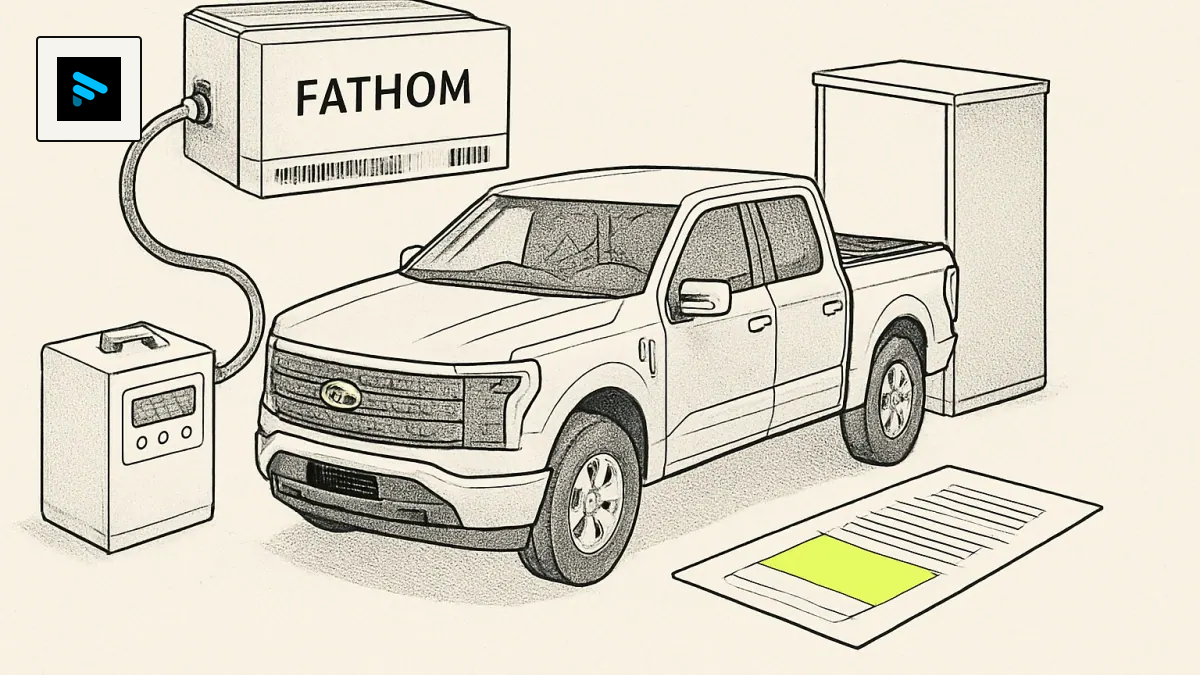
AI generated — machine-made illustration, not a photograph of the event.
If you plan to use an EV as home backup, the Fathom will reduce installation work and the number of external devices you need to budget for.
What actually changed
Ford announced the Fathom, a sub‑$30,000 electric pickup due next year, with the vehicle’s inverter built into the truck. That design lets every Fathom “act as a backup battery for your home” by converting its DC battery output to the AC your house uses inside the vehicle, rather than relying on an inverter installed in a wallbox on the house. The company positioned this as a simpler, integrated approach than the previous Ford setup used for the now‑discontinued F‑150 Lightning, which required a wallbox inverter for vehicle‑to‑home (V2H) operation.
Who it affects
- Prospective Fathom buyers who want their EV to provide emergency or backup power at home: they will get the capability built into the vehicle.
- Households and small businesses that consider an EV as part of their backup‑power plan: fewer external components are required to get V2H functionality.
- Installers and electricians: the on‑vehicle inverter reduces the role of a dedicated wallbox inverter in the V2H workflow, which changes installation steps and the parts list.
All points above follow from Ford’s announcement that the inverter is integrated into the Fathom and that the truck can serve as home backup power.
What it costs or what it replaces
- Price bracket: Ford describes the Fathom as a sub‑$30,000 pickup due next year. The announcement positions the truck at that price point; it does not provide a full pricing breakdown or trim‑level costs.
- What it replaces in a typical V2H setup: an external wallbox inverter that would otherwise convert the vehicle’s DC power to household AC. With the inverter on board, the wallbox’s inverter function is no longer required for V2H operation.
- What the announcement does not state: whether you still need a wallbox for metering, safety disconnects, or convenience functions; whether a reduced‑capability wallbox or other hardware will remain necessary; and any incremental costs for optional accessories or professional installation.
What we don't know
- Exact retail pricing, trim‑level pricing or trim availability beyond “sub‑$30,000”. The announcement does not state pricing details.
- Power and energy capacities for home use: maximum export power (kW) and usable exported energy (kWh) are not specified in the announcement.
- Whether the Fathom supports whole‑house transfer or only selected circuits, and how transfer switches or automatic transfer will be handled.
- Regulatory, safety and certification details for on‑vehicle inverters in home backup roles; the announcement does not list approvals or standards compliance.
- Availability windows and market regions for the Fathom beyond “due next year”.
What to do next
- If you manage fleet or vehicle purchases, pause any immediate buys of a V2H wallbox inverter and add the Fathom to your shortlist; contact a local Ford dealer this week to request any available spec sheet and expected delivery windows so you can compare total procurement costs.
- Ask a licensed electrician to review current backup‑power plans and to estimate integration work assuming the inverter is on the vehicle rather than in the wallbox; get written estimates for both approaches so you can compare installer labour and required hardware.
- If backup power is urgent, keep current contingency plans in place until Ford publishes the Fathom’s export power, supported transfer modes and final pricing; do not rely on the truck alone without those specs.
- Ars Technica — original reporting
Links above go to the original publisher. Signalcraft states the consequence; it does not reproduce their text.
0 comments
No comments yet. If you have run any of this, that is the most useful thing you could add.